> _
Warehouse and logistics operations for small and mid-sized e-commerce
Growing e-commerce companies manage warehouse and delivery processes through spreadsheets and disconnected tools. Order fulfillment status, inventory accuracy, employee performance, and returns are tracked separately.
This fragmentation causes delays, picking errors, and missed delivery issues. As volumes increase, manual control stops scaling, creating the need for custom logistics software development focused on visibility.
Krasty Soft built a centralized efficiency dashboard that brings warehouse, logistics, and returns data into one interface. The product created with low code development enables real-time monitoring and faster reaction to exceptions. Delivered as part of dashboard development services, the solution improves operational control.
Retool, PostgreSQL, Google Sheets, REST APIs, Shopify / ERP integrations, CSV import
Product Scope: Custom Logistics Software for Daily Operations
The dashboard was designed as an operational tool for teams working inside the warehouse. Order fulfillment is displayed in real time using a Kanban-style view. Inventory accuracy, delivery progress, and returns are available without switching systems. Treating the product as custom logistics software ensured that each screen supports fast decisions on the floor.
Functional Areas Covered by Custom Logistics Software Development
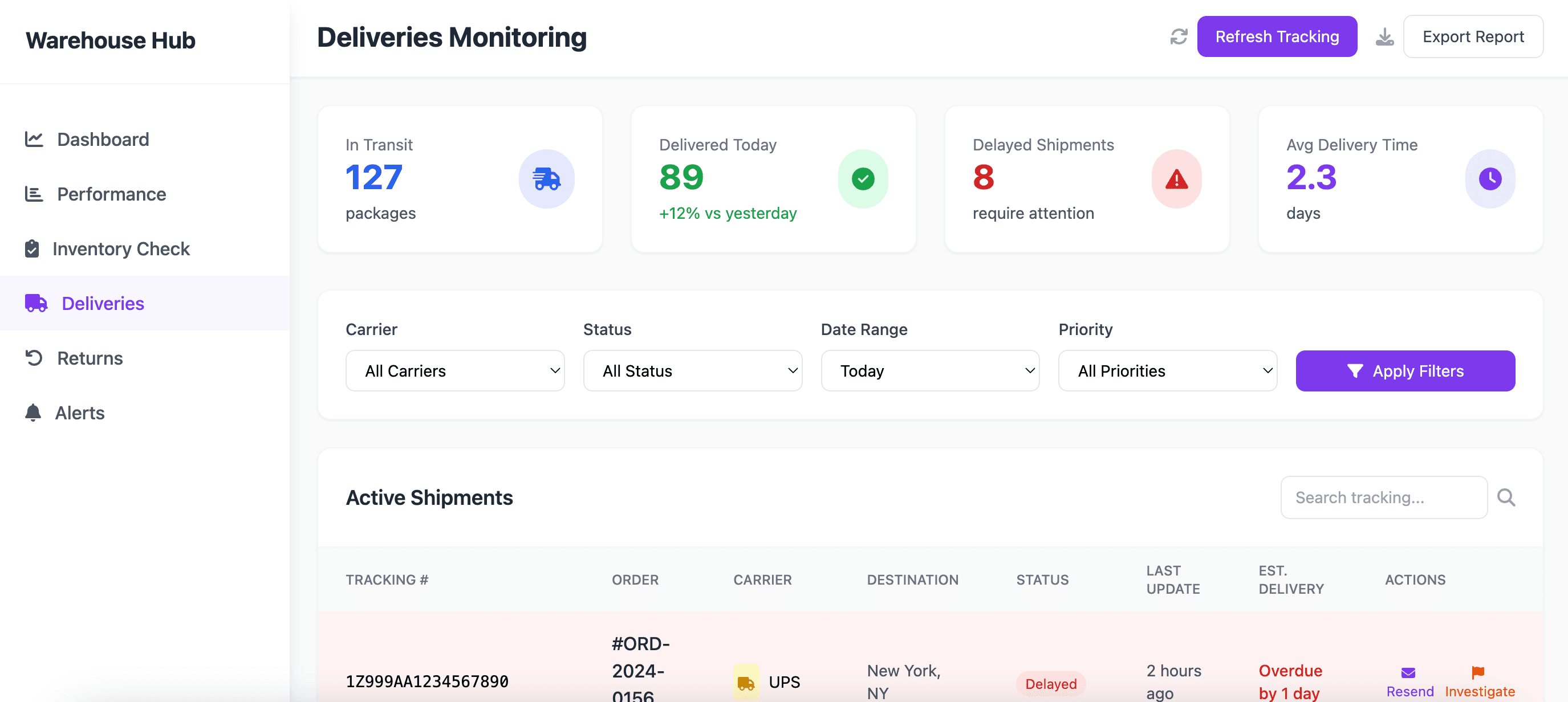
The custom logistics software consolidates multiple workflows into a single workspace:
- Dashboard: order statuses with fulfillment metrics and bottleneck visibility.
- Performance: warehouse productivity, processing time, and error tracking.
- Inventory audit: comparison of expected versus actual stock with accuracy percentage.
- Deliveries: carrier statuses, exceptions, and delayed shipments.
- Returns: inbound return tracking and warehouse intake status.
- Alerts: notifications for stuck orders, zero stock, and operational risks.
Each section reflects real warehouse processes implemented through custom logistics software development.
Architecture and Dashboard Development Strategy
The dashboard is built on Retool as an orchestration layer that queries live data from PostgreSQL, Google Sheets, logistics services, and e-commerce platforms. Instead of duplicating data, the system reads from existing sources. This dashboard development strategy keeps information current and reduces maintenance overhead while preserving data ownership in source systems.
Rapid Delivery with Low Code Development
We used low code development to assemble views, filters, and alert logic quickly while keeping calculations transparent. This allowed fast iteration based on warehouse feedback. Layouts and KPIs were adjusted without touching backend integrations. A second layer supports alert thresholds and KPI tuning as operations evolve.
Operational Control via Custom Logistics Software
The dashboard acts as custom logistics software that highlights issues before they escalate. Managers see where fulfillment slows down. Warehouse staff respond to alerts instead of discovering problems hours later. This shifts operations from reactive to proactive.
Outcomes and Impact of Dashboard Development Services
The dashboard reduced reliance on spreadsheets and manual checks. Teams gained real-time visibility into warehouse health and delivery risks. Order issues were identified earlier, and inventory discrepancies became measurable. Delivered through custom dashboard development, the solution provides a scalable alternative to heavy WMS platforms.
This case demonstrates how custom logistics software development can improve efficiency, accuracy, and response time. It shows that a targeted approach, combined with focused dashboard development services, can deliver meaningful operational gains for e-commerce companies without enterprise-level overhead.